With your upcoming roofing project, you may be wondering ‘what is the best material for a flat roof?’ A flat roof is often seen on an outdoor building such as a garage or shed. However, buildings with a flat roof can include residential as well as commercial buildings.
There are several different materials that are all suitable for a flat roof. However, each has its own benefits and characteristics.
Let’s take a look at the different available options:
Felt Roofing
This is a popular method for both flat and low sloop roofs. Felt roofing consists of using bituminous felts to create durable built-up roofing systems. In addition, this type of flat roofing material is suitable for both residential and commercial buildings.
Benefits of Felt Roofing:
- Affordability: Felt roofing is available at competitive prices. As such, it is one of the cheapest flat roofing materials available. This is a great option if you have a strict budget.
- Ease of Installation: This roofing material is easy and quick to install. It is also a good solution for weekend roofers, or DIY enthusiasts.
- Lightweight: As this roofing material does not weigh much, it is great for sheds, garages, and extensions.
- Easy to Repair: If it becomes necessary, felt roofing is quick and easy to repair. The entire roof does not need replacing as it is easy to patch the area needing repairs.
EPDM Roofing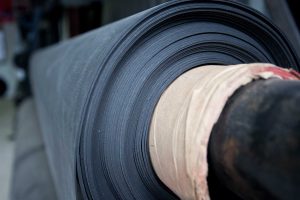

EPDM stands for ethylene propylene diene terpolymer. It is a rubber roofing system and is one of the most modern flat roof materials available today. As a result of its many positive properties, it is a superior, and highly popular flat roof material choice.
Benefits of EPDM Roofing:
- Cost-effective: EPDM roofing is an affordable option, especially for those on a tight budget. This roofing material provides the same level of protection as other roofing materials. However, it is excellent value for money considering its cost.
- Multi Use: This flat roof material is ideal for a range of different applications. As it is flexible and provides a seamless finish, it is a good choice for extensions, offices, workshops, garages and garden sheds.
- Durability and Longevity: An EPDM roof can last up to 50 years. This does depend on the weather of the area, but it is a long-lasting material, nonetheless.
- Easy to Maintain: This roofing material is an excellent choice as it requires very little maintenance to keep it in excellent condition.
GRP Roofing

GRP is glass reinforced plastic, or fiberglass. This type of roofing material is gaining in popularity for both residential and commercial properties. GRP roofing is a durable, low-maintenance, and cost-effective flat roof material.
Benefits of GRP Roofing:
- Resilience: A GRP roof is extremely durable. Furthermore, with the correct maintenance, will last for decades. Another plus point is that it is also resistant to harsh weather conditions and UV radiation.
- Waterproof: This roofing material is water-resistant. As such, it is perfect for flat roofs.
- Minimal Maintenance: A building with a GRP roof requires very little maintenance. Furthermore, it is easy to clean with soap and water.
- Affordable: GRP is an affordable roofing material. In comparison to other roofing materials, this wins hands down.
- Easy to Install: It is easy to install GRP roofing. This can be done over an existing roof or deck, making it a fast and easy roofing solution for a flat roof.
TPO Membrane Roofing
This is an acronym for thermoplastic polyolefin. TPO is a single-ply white membrane used in both commercial and residential flat roofs. As it is a white membrane (and not black like EPDM) it reflects the heat rather than absorbing it.
Benefits of TPO Membrane Roofing:
- Durability: An extremely durable material, they can last for decades. They can withstand the sun’s UV rays and harsh weather conditions. Furthermore, this flat roofing material is also resistant to bacterial growth and dirt buildup.
- Cost Effective: TPO membrane roofing is an affordable option. Considering that it is a durable material, along with its resilience, this is an excellent value-for-money option.
- Energy Efficient: Interestingly, TPO membrane flat roofs are helpful in saving energy. As they reflect the heat, the room below remains at an ambient temperature. This means that heating and cooling costs are minimal. TPO membranes are from recyclable materials. Hence, this means that they have a much lower environmental impact than many other materials.
PVC Membrane Roofing
Polyvinyl chloride flat roofing options are also popular for both commercial and residential flat roofs. This is also a single-ply white membrane.
Benefits of PVC Roofing:
- Ease of Installation: this roofing material is easy to install – great news for the DIY roofer.
- Durable Choice: You can expect a PVC flat roof to easily last for up to 25 years.
- Attractive Cost: PVC is an affordable option. Also, like TPO roofing, is excellent value for money.
Built Up Roofing Material
This particular type of flat roofing material is one of the oldest methods around. The name says it all – it is made with different layers. As such, a layer of asphalt, with some boards or other material, some gravel and other small rocks on top. Thereafter, it has a seal with more asphalt.
Benefits of BUR
- Affordability: this type of roofing material is inexpensive and widely available.
- Durability: BUR is a strong, resilient roof. It also offers excellent protection against storm damage. As such, it can withstand wind, rain, hail, or other flying debris. This type of roof also offers a safer surface to work on in comparison to pother types of flat roof materials. While this is a durable choice, one needs to bear in mind that it can be a heavy roof. As such, the building must be strong and sturdy.
There are several top quality and cost-effective flat roof material options. If you need assistance or advice on any flat roof material, we can assist. Contact North East Roofing Supplies right away. Our experts are on hand to assist you with the best flat roof material available for your specific project.